Commercial Fire Sprinkler Inspection & Testing in Columbus, Ohio
Inspection, testing, and maintenance are how a commercial owner keeps a record of a fire sprinkler system that is already in the building. A single visit can include more than one of them. The report should say which were done.
Service requests will be referred to an independent fire sprinkler contractor holding the required state certifications and applicable local registrations for the work requested.
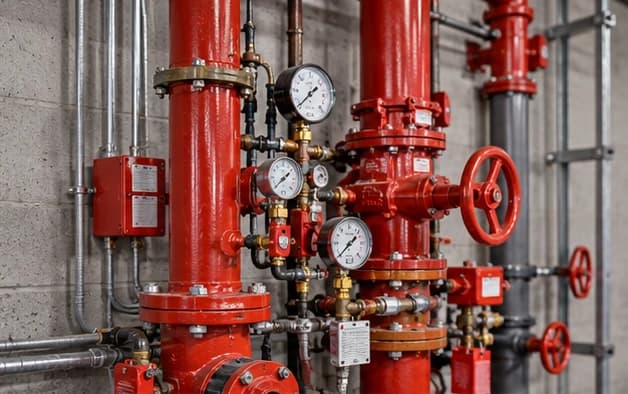
Three different tasks
Inspection
A look at the system and its parts: heads, pipe, hangers, valves, gauges, signs, and the conditions around them. The result is a record of what was observed.
Testing
Operating or measuring something to see whether it works. A main drain test, a waterflow alarm, a valve, a trip test on a dry or preaction system, or a fire pump test. Looking at the riser is not a test.
Maintenance
Work that keeps the system in operating condition, or that corrects what inspection and testing found. Replacing a gauge, cleaning a strainer, or repairing a leak is maintenance or repair. It is not finished because someone looked at the riser.
How often each item comes due depends on the component and on the applicable NFPA 25 provisions. There is no single annual clock that covers every task. Ohio's current Fire Code references the 2023 edition of NFPA 25. The intervals are explained on the inspection and testing schedule page. The state rule on tags and records is on the Ohio requirements page.
What the report should give you
Forms differ by contractor. These are the parts a property manager can look for.
- Observations. What was seen: a valve position, a missing sign, corrosion, storage too close to a head, a gauge that cannot be read.
- Test results. What was operated or measured, and how that result compared with the prior test or the expected range.
- Deficiencies. Conditions the report says need correction. Some forms split them into categories such as critical and noncritical. Read the form's own words on the inspection-report page.
- Impairments. A condition in which the system, or part of it, cannot perform. A closed control valve or a system taken out of service is the usual case. That is more urgent than a missing escutcheon.
- Recommended follow-up. A repair, a part, a retest, or a further look. A recommendation on a report means the work is still open.
- Documentation. The report, the tag at the riser, and prior years in the building file. Ohio's annual inspection tag is summarized on the Ohio requirements page. The tag records that annual visit. It does not prove that every other NFPA 25 task was done.
When a finding needs follow-up
- Inspection or testing is performed, and the result is written down.
- The report identifies the finding as a deficiency, an impairment, or another noted condition. The form's own label controls that.
- A contractor qualified for the work reviews the listed items and proposes the correction.
- The correction is made: deficiency correction when the report is the reason for the work, and repair when a part or a leak has to be fixed.
- Follow-up testing, a new tag, or other documentation is completed when the standard, the insurer, or the fire code official requires it.
The longer path, written for someone who just received a bad report, is what to do after a failed fire sprinkler inspection.
What changes the scope of a visit
The contractor has to see the systems before the scope, and the price, are real. These are the reasons one building's visit is not another's.
- Number of systems and risers, and which types they are
- Wet, dry, and preaction systems on the same property. Dry and preaction systems have tests a wet system does not.
- Which inspections and tests are due, including any internal piping inspection or assessment that is due on a longer cycle
- A fire pump, if the building has one
- Backflow preventers and other devices tested with the sprinkler visit
- Access: locked rooms, high ceilings, occupied floors, after-hours rules
- Known problems that will turn the visit into a repair conversation
A longer list is on the inspection cost factors page.
Fire pumps
A fire pump raises pressure for a sprinkler system, a standpipe, or both, when the water supply cannot meet the pressure the system was designed for. Many commercial buildings have no pump. Their water supply was judged adequate without one.
Where a pump is part of the supply, pump inspection and testing are their own NFPA 25 tasks. A sprinkler visit that never addresses the pump leaves the supply unverified. A pump room, a pump controller, or a jockey pump on a prior report is enough reason to say so when requesting the visit. What to look for in the file is on the fire pump testing page.
A recurring inspection arrangement
Many owners keep inspection, testing, and maintenance on a recurring arrangement with the contractor who performs the work, instead of calling only when a notice arrives.
- Visits are scheduled before a component comes due
- Reports stay in one sequence, so this year can be compared with last year
- Weekly, monthly, quarterly, annual, and multi-year items are not all due on the same day
- A portfolio is easier to track than a stack of one-off visits
- Open deficiencies have a place to sit until they are closed
The useful questions for a proposal are which intervals it covers and how open items are reported back. Why those intervals sit on more than one clock is on the inspection and testing schedule page.
What to have ready
- Property address, building type, and use
- System type, if known, and whether a fire pump is on site
- Date of the last inspection, and the previous report if you can find it
- Known deficiencies, or a notice from the fire department or an insurer
- Any deadline on a notice or a certificate
- Who can give access, and how to reach them
A buyer gathering the existing file, rather than scheduling this year's visit, should start with fire sprinkler records to check when buying a commercial building.
Request fire sprinkler help
Call with the last report, or with the address if the file is missing.
Service requests will be referred to an independent fire sprinkler contractor holding the required state certifications and applicable local registrations for the work requested.